

What's the connection between Sunlight Soap and a monastery on the Bethlehem Road?

I'm writing this on April 1st, but it's no hoax. There is a connection.

Even today, people around the world know Sunlight soap, Lifebuoy soap, Lux soap and Pears transparent soap, all famous brands of Lever Brothers, the world-famous soap makers beside the River Mersey, opposite Liverpool.
The founder of Lever Brothers, William Hesketh Lever, later 1st Viscount Leverhulme, spent his fortune on philanthropy and on art. Through his altruism he built the model villages of Port Sunlight, one of the first (and most beautiful) workers' villages in the world, as well as Thornton Hough, for his estate workers; he endowed the Liverpool School of Tropical Medicine, gave Lancaster House in London to the British nation and endowed the Leverhulme Trust set up to provide funding for publications of education and research.
But even his artistic acquisitions soon took on an altruistic aspect. Having begun collecting artworks in 1893, he founded the Lady Lever Art Gallery in Port Sunlight 1922, dedicated to his late wife, as a memorial and free museum for his workers and the wider public. The museum was eventually given to the nation and is now a part of National Museums Liverpool.
Now Leverhulme's collection in the Lady Lever Art Gallery - with which I grew up as a child and got to know over many decades of frequent visits - is varied and eclectic, from 18th to 20th century paintings and sculpture, to English furniture, Wedgewood and jasperware, Chinese ceramics, and other objects, such as Ancient Greek vases and Roman sculpture. It is particularly strong in British 19th-century painting and sculpture, and especially the pre-Raphaelites.
One of these pre-Raphaelites, William Holman Hunt, painted a number of pictures with Jewish themes and scenes from the Holy Land, and among my favourites - and later on my wife's when I introduced her to the collection, was The Scapegoat, a picture of the said animal standing in the salt flats at the edge of the Dead Sea, with a sunset reflecting the myriad colours of the Judean desert and the Mountains of Moab in the background.

Self Portrait, William Holman Hunt, 1867, Galleria degli Uffizi, Firenze.
Holman Hunt left London for the first of several pilgrimages to the Holy Land in 1854 and even built himself a house and studio in Jerusalem in 1869, at 64, Street of the Prophets. He was keen to experience the actual locations of the Bible in order to render authentic interpretations of biblical scenes. The Scapegoat was his first major painting executed in the Holy Land, followed by The Finding of the Saviour in the Temple and The Shadow of Death, along with many landscapes of the region. He came up with the subject of the scapegoat after reading the Book of Leviticus shortly after arriving in Jerusalem: the ritual was enacted on the Day of Atonement and involved two goats, one of which was slaughtered as a sacrificial offering in the temple, the other being sent out of the city symbolically carrying with it the sins of the people, banished to a land that was uninhabited.
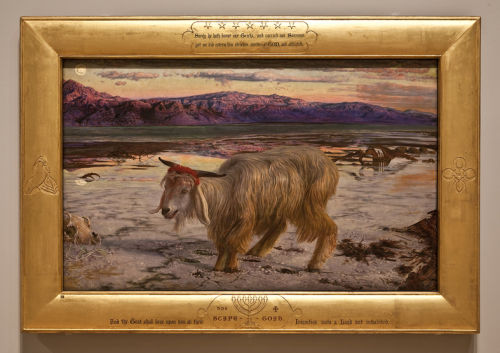
The Scapegoat, William Holman Hunt, 1854-56, Lady Lever Art Gallery, Port Sunlight.
In his quest for realism, Hunt traveled over inhospitable and dangerous terrain to the shores of the Dead Sea. In his diary, he described the site of Osdoom (Mount Sodom, Jebel Usdum) with the mountains of Edom in the distance as ‘a scene of beautifully arranged horrible wilderness’. He chose the site as it was believed to have been the original location of Sodom. Accompanied by guides, Hunt made a number of trips to the site; during his first visit he had experienced a rainbow which he included in a preliminary painting (now in Manchester Art Gallery) but omitted in the larger work in the Lady Lever, which was the one he eventually exhibited.
The frame was designed by the Holman Hunt as an integral part of the work, intended to complement the painting with quotes from Leviticus and Isaiah, and a combination of Christian and Jewish symbolism.

The Scapegoat hanging in the main hall of the Lady Lever Art Gallery, Port Sunlight, with the author's mother reading about it on the adjacent display, 2014.
Getting closer...
Holman Hunt had a spot where he liked to sit, looking out across the Judean desert towards the Dead Sea and Moab, and indeed he painted a number of works there. After his death, his (second) wife, Edith Waugh erected a stone bench there in his memory. That spot is on the side of the Jerusalem-Bethlehem Road, facing the Mar Elias Greek Orthodox Monastery.

The Holman Hunt bench, with Mar Elias monastery in the background.
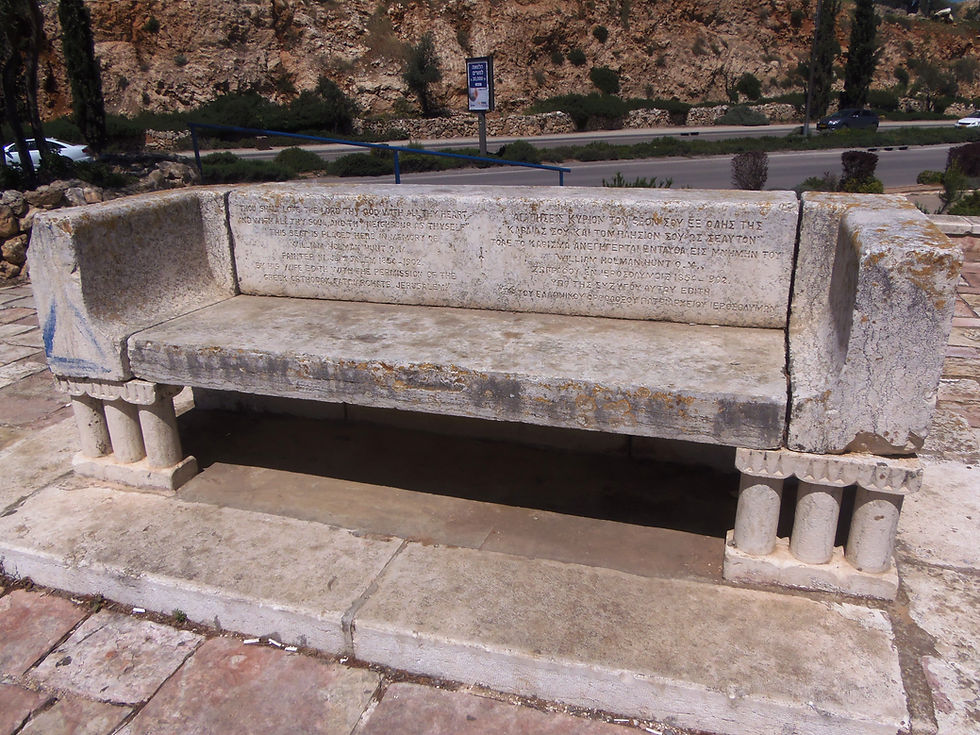
The Holman Hunt bench, with the Jerusalem-Bethlehem road in the background.
So there you have it! What a small world, linking aspects of the author's life across the years! The bench is inscribed with biblical verses in Hebrew, Greek, Arabic and English.
The main inscription on the bench quotes Deuteronomy 6:5 from the Shema (וְאָהַבְתָּ אֵת יְהֹוָה אֱלֹהֶיךָ בְּכָל לְבָבְךָ וּבְכָל נַפְשְׁךָ וּבְכָל מְאֹדֶךָ) and Leviticus 19:18 (וְאָהַבְתָּ לְרֵעֲךָ כָּמוֹךָ) in its combined quotation by Jesus in Luke 10:27. It reads (in English and Greek):
"Thou shalt love the Lord thy God with all thy heart and with all thy soul. And thy neighbor as thyself. This seat is placed here in memory of William Holman-Hunt, painter in Jerusalem 1854-1902, by his wife Edith, with the permission of the Greek Orthodox Patriarchate, Jerusalem."

Detail of the main inscription.
On the left arm of the bench is a Hebrew inscription (היל מעוזי חיל ויתר תמים דרכי - God has fortified me with strength and He looseth perfectly my path - 2 Samuel 22:33), and on the right arm an Arabic one. whose inscription I cannot find in translation.

Detail of the Hebrew inscription.

Detail of the Arabic inscription.

Explanatory plaque adjacent to the bench.

View of the Judean desert, beloved of Holman Hunt, now sadly marred by a fence around an extension of the monastery buildings of Mar Elias. Herodiyon can be seen on the horizon, centre.

The author and family enjoying the Holman Hunt bench!
Comments